The canon never stands still
Canon paper no.8
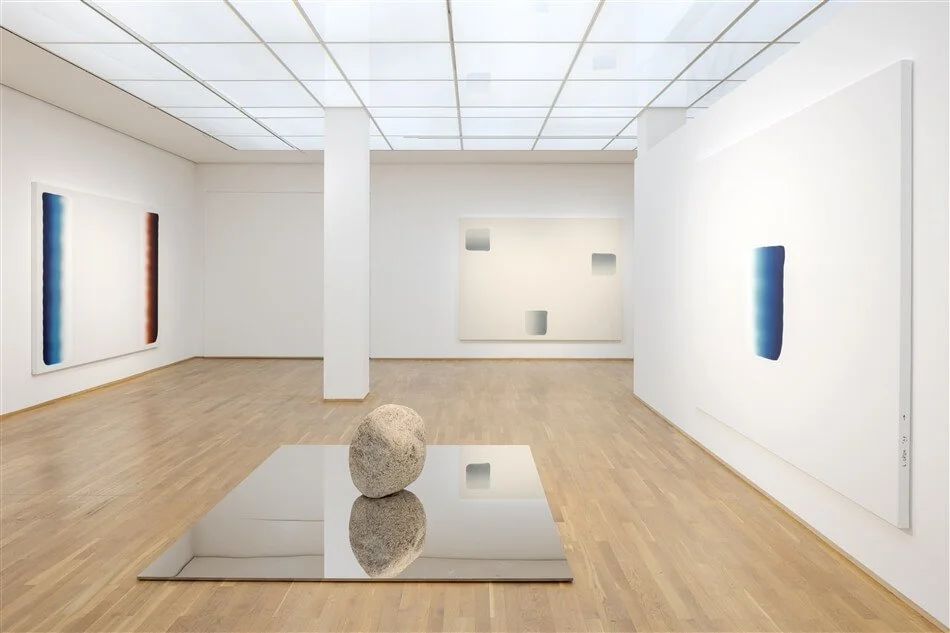
Image courtesy of Studio Lee Ufan
There is an assumption buried in most conversations about the canon, rarely stated outright: that it is something closed. A list, finished by an earlier generation, that later work either gets added to or does not. Under this assumption, the interesting question is always about individual artists — will this one get in.
The more interesting question is about the canon itself. It changes. Not randomly, and not easily, but it changes — and the way it changes reveals something about who currently holds the authority to change it, which turns out to be a more complicated story than "good new work eventually gets recognised."
Consider two artists whose work reached full institutional consolidation in the West by very different routes, at very different speeds. Lee Ufan helped found a movement in Tokyo in 1968. He was invited to the São Paulo Biennial the following year, and to the Paris Biennial two years after that — early, genuine international engagement. It would be more than four decades before that engagement fully consolidated into what it has since become: representation by major Western galleries, a dedicated museum built for his work on the Japanese island of Naoshima, sustained presence in the institutions that anchor the Western art world. Four decades is not a short lag. It is close to the length of an entire career.
Ahmed Mater's trajectory looks different. A Saudi artist, medically trained, self-taught as a photographer through his own clinical practice, he co-founded an artists' collective in the city of Abha at eighteen. Nine years later, his work appeared in a group exhibition at the British Museum. Three years after that, in 2009, he was part of the first presentation of Gulf artists ever included in the Venice Biennale. Seven years after that, in 2016, the Smithsonian gave him a full solo retrospective. From founding a collective to a Smithsonian retrospective: under twenty years. Less than half the time Lee Ufan's consolidation took.
Both artists worked entirely outside the Western institutions that, historically, have done most of the deciding about who becomes internationally significant. Both eventually arrived. The gap in how long it took each of them is not a minor detail. It points to something about how the canon actually expands, and it is worth being careful and honest about what that something is, because this is exactly the kind of claim that is easy to overstate.
Canon expansion describes the process by which the canon — understood not as a fixed list but as the continuously reaffirmed pattern of whose legitimacy the institutional ecosystem has chosen to carry forward — comes to include artists, movements, and regions it did not previously include. This is not the same process as an individual artist's canon formation, examined in the previous paper. That process concerns one artist's trajectory through institutions that were already, in some sense, prepared to recognise work like theirs. Canon expansion concerns something harder: institutions extending recognition to work that does not fit the categories they were already using.
Here is the part of the mechanism worth understanding, because it explains the gap between Lee Ufan and Mater better than anything about the work itself. The institutions capable of expanding the canon are, themselves, products of the canon as it currently stands. Their authority — a major museum's authority to say a movement matters, a biennial's authority to say an artist is significant — was built by validating the artists and movements that came before. When such an institution extends recognition somewhere genuinely new, it is not acting from outside its own history. It is stretching a framework it inherited, and that framework does not stretch evenly or automatically. It stretches where a bridge already exists, or where a new one gets deliberately built.
For a movement like the one Lee Ufan helped found, that bridge, for decades, did not exist in any structured way. Recognition depended on individual curators, individual collectors, individual moments of attention, accumulating slowly and somewhat by accident, until enough of them had happened that Western institutions could no longer treat the work as peripheral. This is one path canon expansion can take — call it a bridging path, dependent on scattered, uncoordinated points of contact building up over a long stretch of time.
Mater's path looks different because the bridge was built differently — and more deliberately. Institutions like the Sharjah Biennial and coordinated platforms such as Edge of Arabia were established, in significant part, specifically to create structured points of contact between artists working in the Gulf region and the Western institutions whose attention mattered for international recognition. That is not a slower version of the same accidental process. It is a different mechanism: institutional capital built intentionally, rather than a bridge that had to accumulate through scattered chance encounters.
This distinction is offered carefully, and it should be. It rests, at present, on a small number of documented cases, and it deserves to be tested against more before it is treated as settled rather than as a pattern worth watching.
One further point needs to be stated plainly, because it bears directly on everything in this paper. The institutional ecosystem being described throughout this series is, at the time of writing, predominantly Western in composition and historical formation. This is a structural feature of where the evidence currently comes from — not a claim about where artistic significance actually originates, or a suggestion that work outside this ecosystem matters less. It is, if anything, the reason canon expansion is worth studying carefully at all: because the process by which this particular, historically dominant set of institutions decides what falls inside its boundaries has consequences for far more artists than the number of institutions involved would suggest.
None of this means the canon expands whenever it should, or that the bridges being described here are fair, or sufficient, or move at a pace anyone ought to be satisfied with. It means the expansion that does happen follows a mechanism, not a mystery — and understanding that mechanism is different from approving of it.
What all of this means for anyone actually trying to build a collection with institutions this uneven, this historically shaped, and this slow to fully accept new work — that is a different kind of question than the ones this paper and its predecessors have asked. It is the question the second half of this series turns to next.