How the Contemporary Art World Actually Works
Canon paper. No. 2
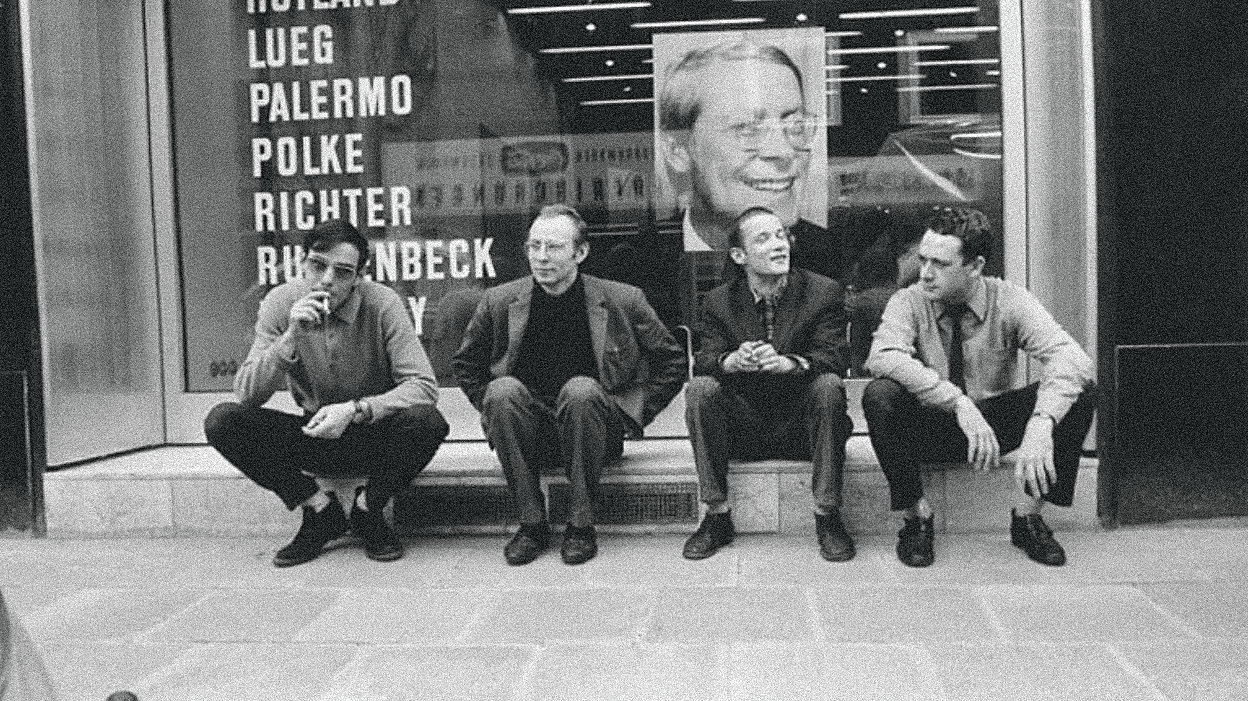
Gerhard Richter, Konrad Lueg, BLinky Palermo and Simar Polke, 1967
Ask most people how an artist becomes important, and they will describe something like a talent show. Someone makes strong work. A gallery notices. A collector buys. A museum eventually agrees. The better the work, the faster and more certain this chain of events.
It rarely works this way, and the reason is not that the art world is corrupt or arbitrary. The reason is that no single actor in this chain has the authority to decide anything on their own — and once you see why, the whole picture changes.
Take a concrete case. In 1963, a young Düsseldorf artist named Konrad Lueg helped organise a one-day exhibition in a furniture shop with three friends, one of whom was Gerhard Richter. Lueg was not a curator at the time. He was not affiliated with any institution. A few years later he stopped painting entirely and reopened as a gallerist, under the name Konrad Fischer, and began showing the same circle of artists — including Richter — from a small space in Düsseldorf.
Nothing about this guaranteed anything. A gallery show, even a good one, is not proof that an artist matters. What happened next is the part worth paying attention to: over the following decade, Richter was invited to represent West Germany at the Venice Biennale, selected independently for documenta by curator Harald Szeemann, and eventually acquired by the Museum of Modern Art — each of these decisions made by a different institution, with different staff, different budgets, and no obligation to agree with each other.
This is the actual mechanism, and it is worth stating plainly because it is so often skipped over: no institution validates an artist by itself in a way that settles the matter. A gallery show creates visibility and access — it puts the work in front of the people whose job is to make further judgments. A biennial selection is one curator's argument, made to a committee, about which artists deserve a specific kind of international attention. A museum acquisition is a different argument again, made by different people, under different institutional pressure, often years later. Each of these actors is doing something distinct, and each one's decision is, on its own, reversible and contestable.
What makes an artist's position durable is not that any one of these actors is powerful enough to decide alone. It is that several of them, working independently, keep arriving at the same conclusion.
This is why it is more accurate to think of the art world not as a hierarchy with a single authority at the top, but as an ecosystem of actors — museums, galleries, biennials, universities, publications, critics, and serious collectors — each performing a different function, none of them in charge of the whole. Museums preserve and publicly legitimise. Curators construct arguments through the exhibitions they build. Collectors support and lend work, giving it visibility outside the primary market. Critics and scholars interpret the work and place it in a broader intellectual context. None of this is centrally coordinated. There is no single office that decides who matters.
This is not the same as saying the system is flat or that everyone's judgment counts equally — a claim that would be just as misleading as the talent-show version. Some actors in this ecosystem carry more weight than others, and that weight is not something an institution can simply declare for itself. A young regional gallery and the Museum of Modern Art are not equivalent validators, and no amount of self-promotion changes that. What gives an institution real weight is its own position within the same ecosystem — its history, its track record of decisions that later institutions went on to confirm, and the degree to which other authoritative actors already take it seriously. This is, in other words, a system of mutual reference, not a fixed ranking handed down from above.
That reference structure has a practical consequence worth sitting with: a validation event only means as much as the standing of the actor performing it, and that standing is not visible on the surface. A press release calling something "museum quality" is not the same as an actual museum, with its own internal review process, deciding to acquire it. Two galleries can look similarly polished and occupy entirely different positions in terms of how much weight the art world actually gives their judgment.
None of this makes the system opaque or impossible to read. It simply means the question worth asking is different from the one most people ask. Not has this artist been shown somewhere — almost every artist has been shown somewhere. The more useful question is which actors, and what does their own position in the ecosystem tell you about how much their judgment is likely to matter later.
That question — how to tell the difference between an institution whose validation carries real weight and one whose validation carries very little — is where the next paper begins.