Why Fame Is Not Institutional Relevance
Canon paper no.1
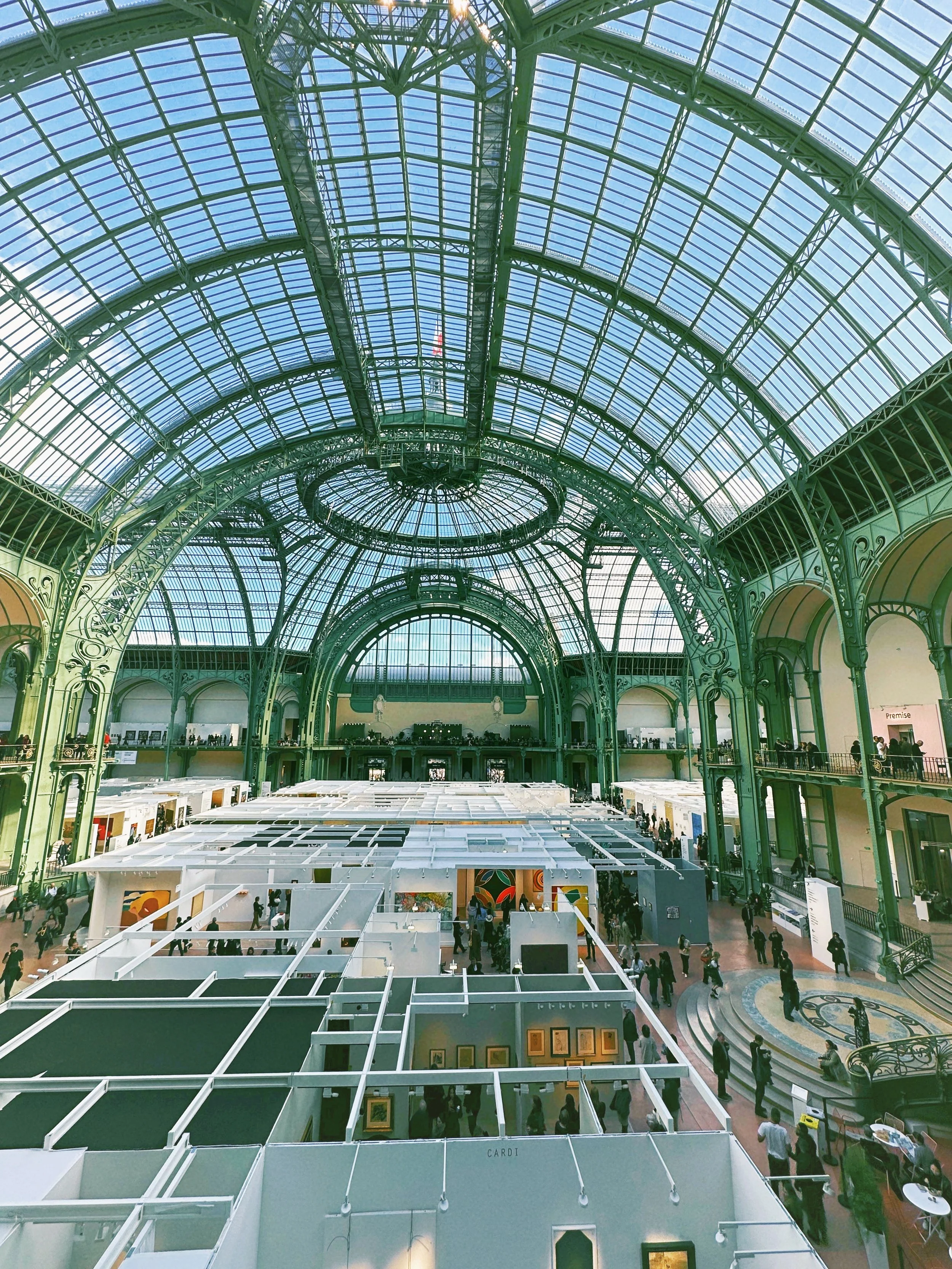
Art Basel Paris
Most collectors, when they explain why they bought a work, point to recognition. Everyone knows the artist. The work has appeared in the news, on Instagram, at auction, or in conversations among other collectors. Recognition feels reassuring because it is visible. It looks like proof that the work matters.Yet public recognition and an artist’s position within the institutions that shape art history are different things. They sometimes overlap, but there is no reliable reason to expect them to. An artist can be internationally famous while remaining only loosely connected to the institutions that determine what is preserved, studied and remembered. Another can be almost invisible outside the art world while occupying a remarkably strong institutional position.
The difference becomes clear when you compare two real careers.
One artist has produced works that sell for tens of millions of dollars. His images circulate constantly, his auctions make headlines, and people with little or no interest in contemporary art recognise his work immediately. Despite that level of fame, he has never been the subject of a solo exhibition independently organised and curated by a major museum. He has never followed the conventional model of long-term gallery representation either. Instead, he built an alternative system around his own practice, including an authentication office and a public refusal to permit unauthorised exhibitions. The result is unusual: extraordinary public visibility alongside a much narrower institutional footprint. Museum archives, exhibition histories and the relatively small body of academic writing devoted to his work show genuine institutional engagement, but only through a limited number of channels. It is a very different pattern from the dense network of museum exhibitions, biennials and scholarly attention that surrounds artists who have become fully integrated into the institutional history of contemporary art.
Now consider another artist. Sergej Jensen was born in Denmark and trained at the Städelschule in Frankfurt. Today he works between Berlin, Cologne and New York, while exhibiting with several leading galleries across Europe and the United States. His paintings—stitched, bleached and often made from raw canvas or linen—belong to the permanent collections of the Museum of Modern Art, Tate and the Centre Pompidou. Just two years after graduating he was invited to the São Paulo Biennial. Two years later he appeared in both the Whitney Biennial and the Berlin Biennale. Outside specialist circles, however, his name is unfamiliar. He rarely attracts media attention, and most people have never encountered his work. Within the institutional world of contemporary art, the picture is almost the opposite. Over two decades, museums, curators and major exhibitions have repeatedly arrived at the same conclusion independently of one another: that his work deserves a lasting place in their collections and exhibitions.
Placing these two careers side by side exposes an important distinction. If you ask which artist is more likely to occupy a significant place in art history fifty years from now, many people instinctively begin separating two ideas they had previously treated as identical. Public fame and institutional significance are not interchangeable.
Institutional relevance describes the extent to which an artist has been absorbed into the network of institutions responsible for preserving and transmitting art across generations. Museums, biennials, curators, scholars and serious collectors all contribute to that process. The question is not how many people recognise an artist’s name. It is whether the work has entered the comparatively small but influential system that determines what continues to be exhibited, researched and discussed long after market enthusiasm has faded.
This distinction is neither a matter of taste nor an expression of cultural snobbery. It can be observed directly by looking at the kinds of recognition an artist has received and, just as importantly, where that recognition comes from.
Not every form of recognition carries the same meaning. A feature in a magazine, widespread attention on social media or a record-breaking auction result may indicate visibility, but they tell us relatively little about an artist’s long-term place within the history of art. A museum acquisition is different. Before a work enters a permanent collection, a curator must usually make a case for it, often before colleagues, directors and acquisitions committees whose role is to question the decision as much as to approve it. The process is slow, argumentative and selective. It asks whether a particular work deserves a place in the historical record the institution is trying to build.
A viral image operates through an entirely different mechanism. It spreads because algorithms amplify it, because journalists pick up a story, or because the timing happens to be right. None of those things makes the attention unreal. They simply measure something different. Public attention and institutional judgment answer different questions, even if they occasionally point in the same direction.
The broader pattern matters more than any single event. One museum acquisition tells us that one institution found the work compelling enough to preserve. That is meaningful, but it remains only a single decision. The picture becomes far stronger when separate institutions, working independently and often in different countries, arrive at similar conclusions over a sustained period.
Sergej Jensen’s career illustrates this well. His invitation to the São Paulo Biennial, followed shortly afterwards by appearances in both the Whitney Biennial and the Berlin Biennale, did not originate from one curator repeatedly promoting the same artist. Nor did the subsequent acquisitions by the Museum of Modern Art, Tate and the Centre Pompidou. Each decision emerged from a different institution, with its own curators, priorities and internal processes. No single organisation controlled the others, yet they repeatedly reached comparable conclusions about the significance of the work.
That kind of convergence is difficult to manufacture. Publicity can generate attention, and market success can reinforce itself, but convincing multiple independent institutions over many years is another matter entirely. Every acquisition, exhibition or biennial invitation involves its own evaluation and its own willingness to commit institutional resources. When those decisions accumulate across different organisations, they become increasingly difficult to explain as coincidence or momentum alone. The simplest explanation is often the strongest one: a growing number of institutions genuinely consider the work historically important.
Fame does not depend on this process. A single image, an exceptional auction result or a controversy can propel an artist into global public consciousness almost overnight. Institutional relevance develops differently. It is usually the result of many separate decisions made over long periods of time. Each decision is relatively modest on its own, but together they form a pattern that becomes increasingly stable and increasingly difficult to reverse.
This does not mean the two forms of recognition are mutually exclusive. Many canonical artists are both widely known and deeply embedded within museums, biennials and scholarship. The point is more limited than that. Public fame should never be treated as evidence of institutional relevance, nor should a lack of public recognition be taken as evidence against it. They describe different dimensions of an artist’s career and therefore need to be assessed independently.
The distinction has practical consequences for anyone trying to evaluate a work of art rather than simply react to its reputation. Instead of asking how famous an artist is, it is more useful to ask a different set of questions. Which institutions have chosen to engage seriously with the work? Have those decisions been made independently, or do they all trace back to the influence of a single gallery, curator or market narrative?
Those questions are not always easy to answer. Institutional recognition rarely announces itself in a simple or transparent way, and it cannot be reduced to a single exhibition, acquisition or review. What matters is the broader pattern. Are different museums collecting the work? Are biennials selecting the artist without relying on the same network of advocates? Is the work attracting sustained scholarly attention over time? The more independent these decisions are, the more persuasive they become as evidence of lasting institutional relevance.
Looking at institutions in isolation is therefore not enough. They exist within a larger ecosystem, and that ecosystem has its own structure. Museums influence one another without moving in lockstep. Curators develop independent programmes while remaining aware of wider conversations. Scholars, collectors and biennials all contribute to the formation of an artist’s reputation, but they do so in different ways and under different incentives. Understanding institutional relevance requires understanding how those relationships work.
This is why isolated achievements can be misleading. A prestigious acquisition is significant, but it remains one decision. A biennial invitation is important, but it reflects the judgment of a particular curatorial team at a particular moment. What carries greater weight is repetition across independent institutions over time. When museums, biennials and scholars continue to arrive at similar conclusions without obvious coordination, the resulting pattern becomes increasingly difficult to dismiss as chance, fashion or market momentum.
Seen in this light, institutional relevance is less a matter of prestige than of accumulated evidence. It emerges gradually through many independent acts of selection, each modest on its own but collectively forming a durable record of sustained attention. That record does not guarantee an artist’s place in history, but it provides a far stronger indication than public visibility or market success alone.
For collectors, this changes the way evidence should be interpreted. Public recognition remains interesting, and it can certainly influence the market, but it should not be mistaken for proof of historical significance. The more revealing question is whether the artist’s work has persuaded institutions whose primary responsibility is not to follow public attention, but to decide what deserves to be preserved, studied and passed on.
Answering that question demands more than checking a handful of facts. It requires understanding how institutions relate to one another, where their judgments originate and whether apparent consensus reflects genuinely independent decisions or simply the repetition of a single influential source. Only then is it possible to distinguish between recognition that is merely visible and recognition that is likely to endure.
Thanks for reading! Subscribe for free to receive new posts and support my work.