What Makes Relevance Durable
Canon Paper No. 5
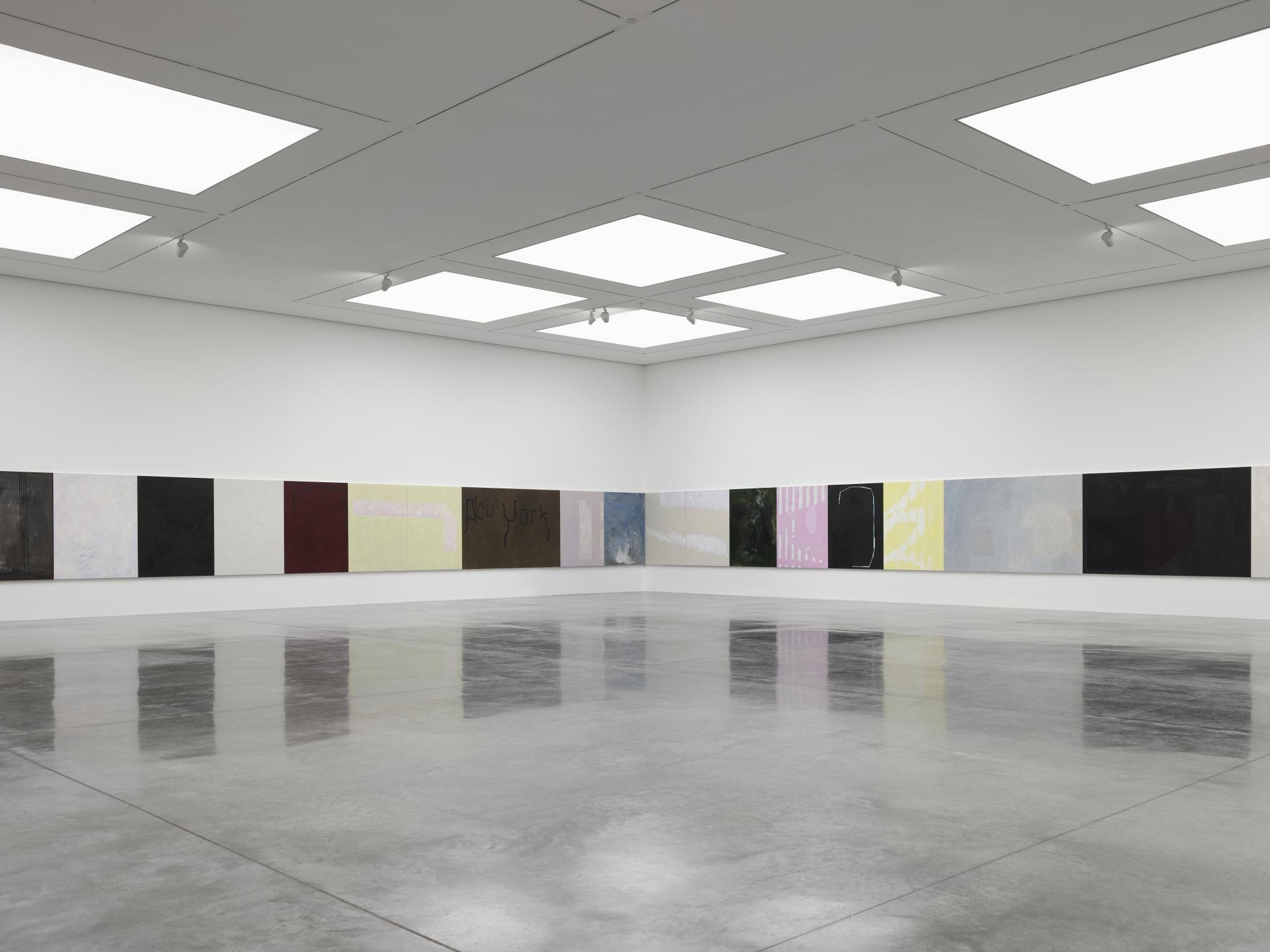
Exhibition Sergej Jensen at White Cube - courtesy of the artist
Here is a question worth asking about any artist whose reputation currently looks strong: if all attention stopped tomorrow — no new exhibitions, no press, no gallery programming — would anything remain?
For most artists at most points in their careers, the honest answer is very little. Reputation of the ordinary kind is a live signal. It requires continuous input. Stop showing the work, stop writing about it, stop inviting it into exhibitions, and within a few years the position it once held simply erodes, because nothing was actually holding it in place except the activity itself.
But not always. Consider Sergej Jensen's paintings sitting in the permanent collection of the Museum of Modern Art, or the several thousand articles, photographs, and exhibition records the Gerhard Richter Archive has assembled and continues to maintain in Dresden — an institution built specifically around one artist's work, staffed, funded, and operating independently of whatever exhibitions that artist has scheduled this year. Neither of these things depends on continued programming to remain true. If Jensen never had another solo show, the MoMA painting would still be in the collection. If Richter stopped producing tomorrow, the Archive would not close; cataloguing a life's work, once begun at that scale, does not require the life's work to keep growing.
This is a different kind of institutional position than the one most exhibitions produce, and it is worth being precise about what makes it different. An exhibition is an event. It happens, it draws attention, it closes. What remains afterward is whatever the exhibition managed to produce that outlasts it — and very often, that is nothing at all beyond a catalogue and some photographs. A permanent collection acquisition is not an event in the same sense. It is a standing fact. It does not close. It requires no renewal.
The same is true, in a different register, of independent scholarship. When a doctoral dissertation is written about an artist's work — examined, defended, and later published — that is not contingent on the artist's ongoing visibility either. A scholar at a university, working independently of any gallery or museum's programming calendar, decided the work was substantial enough to build years of research around. That judgment, once made and formalised, does not evaporate if the artist's market goes quiet or a gallery relationship ends.
This distinction has a name worth using precisely: durability of embedding. It describes whether institutional engagement with an artist's work has taken a form that persists on its own — a collection, an archive, a body of independent scholarship — or remains dependent on continued, discrete acts of attention to stay intact. The two are easy to confuse from the outside, because both can look, in the moment, like serious institutional recognition. A major solo exhibition and a permanent collection acquisition can generate the same headline. They do not leave the same thing behind once the headline fades.
The distinction matters because it resolves a puzzle that otherwise looks like an exception to everything the previous papers have argued. Repetition and independence, as described earlier, are usually what separate real institutional standing from a single lucky break. But repetition on its own can be misleading if it is repetition of the wrong kind — an artist can be re-exhibited at intervals for years, each show temporary, each one leaving no lasting institutional trace once it closes, producing an impression of sustained relevance that is actually just a sequence of separate, forgettable moments. Durability of embedding is what tells the difference between an artist whose validation is accumulating into something permanent, and an artist whose validation is simply being repeated.
It is also, for that reason, one of the earliest reliable signals available — often visible well before an artist's broader reputation has caught up with it. A permanent collection acquisition can happen quietly, years before a major retrospective makes the position publicly obvious. Watching for this kind of event, rather than waiting for the moment an artist becomes widely discussed, is one of the more useful habits a serious collector can develop, precisely because it tends to arrive first.
None of this means exhibitions are unimportant. They are, in most cases, how an artist's work reaches the people — curators, scholars, other institutions — who eventually decide whether something more durable is warranted. But the exhibition is the argument. Durable embedding is what happens when the argument succeeds.
Once relevance has taken this more durable form, a further question becomes possible — one about whether it has become not just durable, but genuinely difficult to reverse. That is a different threshold, and the next paper is about crossing it.